

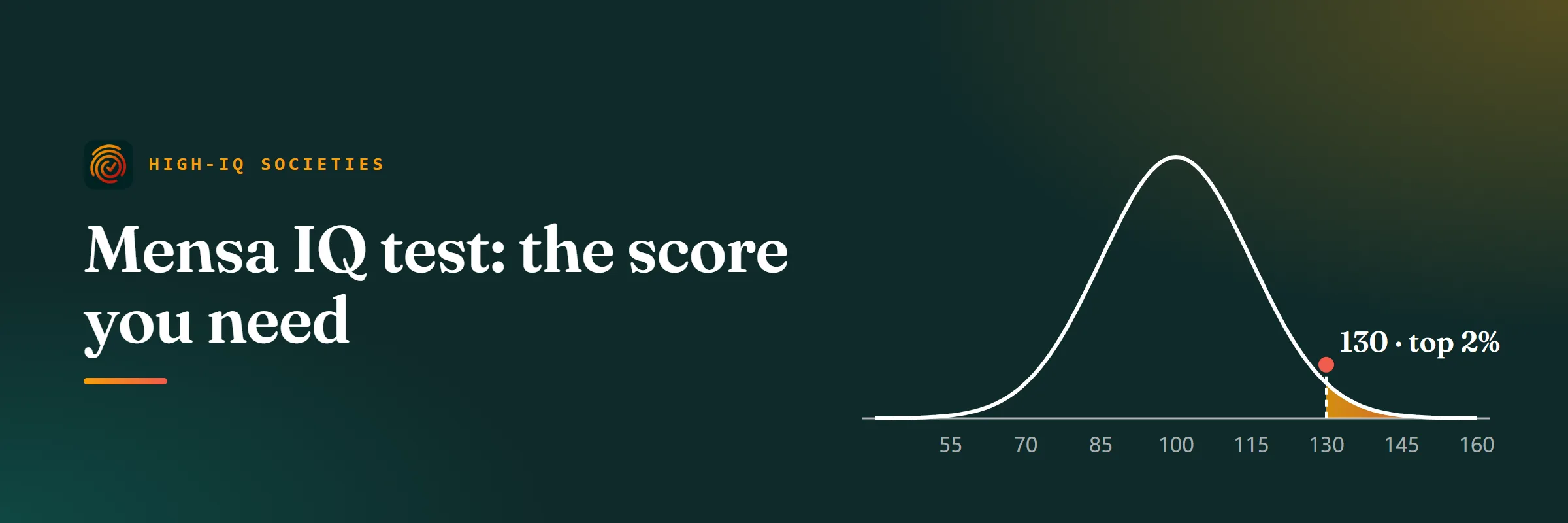
There is no single "Mensa IQ test". Mensa has one entry rule, a score in the top 2% of the population, and accepts it from several approved tests taken under supervision. This guide covers the qualifying score on each common scale, the two ways to qualify, the tests used in different countries, and what a free online test can and cannot tell you before you book.
What is Mensa?
Mensa is the oldest and best-known high-IQ society. It was founded in Oxford, England, in 1946 by Roland Berrill and Lancelot Ware, and the name comes from the Latin word for table, chosen to suggest a round table of equals. Today it runs national groups in many countries under Mensa International, with local events, special interest groups and a magazine. Members share one thing: a qualifying score on an approved intelligence test.
The Mensa qualifying score
Mensa's rule is a percentile, not a number: you must score at or above the 98th percentile, higher than 98 in 100 people. The number that matches that rank depends on how a test spreads its scores, which is set by its standard deviation.
| Test scale | Standard deviation | 98th percentile (computed) | Usually quoted |
|---|---|---|---|
| Wechsler scales (WAIS, WISC) | 15 | 130.8 | 130 |
| Older Stanford-Binet editions | 16 | 132.9 | 132 |
| Cattell III B (used by British Mensa) | 24 | 149.3 | 148 |
Computed from the normal curve: the 98th percentile is 2.054 standard deviations above the mean. The quoted figures are the round numbers Mensa groups usually publish; each branch sets the exact qualifying score for every test it accepts.
So a 130 on the WAIS and a 148 on the Cattell III B mean the same thing: the top 2%. When people quote a "Mensa IQ" of 148, they are using the Cattell scale, not a stricter rule.
How to qualify for Mensa
1. Take Mensa's supervised test
Most national Mensa groups run their own supervised testing sessions, in person or proctored online. The test is timed and scored against norms, and a result in the top 2% qualifies you to join. Contact your national Mensa for dates, fees and the test it uses.
2. Submit prior evidence
If you have already taken an approved test, such as the WAIS, the WISC or the Stanford-Binet given by a psychologist, you can usually send that result instead. Some national groups also accept certain older school or college admission test scores. Each branch keeps its own list, so check before you apply.
The tests Mensa uses around the world
- American Mensa runs its own Mensa Admission Test at supervised sessions and accepts scores from a long list of approved tests.
- British Mensa uses a supervised session based on the Cattell III B and a culture-fair test, which is why British cut-offs are often quoted on the Cattell scale.
- Other national groups use their own approved tests, often non-verbal reasoning tests that work across languages.
- Mensa Norway online test: 35 pattern puzzles in 25 minutes. It is free and widely shared, but it is for practice and entertainment only and does not qualify you.
Can an online IQ test get you into Mensa?
No. Online tests are unsupervised, so nobody can confirm who took them or under what conditions, and most are not normed like clinical tests. What a careful online test can do is tell you whether booking a supervised session makes sense. If you score clearly above 130, you are a reasonable candidate; if you score far below it, a supervised test is unlikely to change that much.
Our free test uses 32 puzzles with a 25-minute limit and shows a 90% range around your estimate. If that range reaches 130 or above, a supervised test is worth trying.
How to prepare for a Mensa test
- Learn the formats. Matrix puzzles, number and letter series and spatial items make up most reasoning tests, and practising each puzzle type with worked answers shows the rules they rely on.
- Practise under time. Most supervised tests are timed, and running out of time costs more points than any single hard item.
- Sleep, eat and arrive early. Tiredness and stress can move a result by several points.
- Do not over-train on one test. Familiarity helps a little; memorising items does not raise your real ability, and some branches limit retakes.
What a Mensa score does and does not mean
A qualifying score means you did very well on one standardised reasoning test on one day. It does not measure creativity, judgement, knowledge or persistence, and a person at 128 and a person at 131 are far more alike than the Mensa line suggests. Every score carries a margin of error of several points, which is why near-misses sometimes qualify on a second, different test.
Higher-IQ societies beyond Mensa
Mensa is the best known high-IQ society, but not the strictest. Several smaller societies set higher thresholds. Here are their published levels, converted to the standard scale with a standard deviation of 15:
| Society | Admits | About this IQ (SD 15) |
|---|---|---|
| Intertel | top 1% | about 135 |
| Triple Nine Society | top 0.1% | about 146 |
| Prometheus Society | 1 in 30,000 | about 160 |
| Mega Society | 1 in a million | about 171 |
Conversions computed from the normal curve. At these heights few tests measure reliably, so these societies keep their own lists of accepted tests.
Is Mensa membership worth it?
Membership is mainly social. Members get local meetings, special interest groups covering hobbies from chess to astronomy, national gatherings and, in some countries, scholarships run by Mensa foundations. The credential carries little weight with employers, and membership fees vary by country. Many people take the test once just to find out, and never join.
Frequently asked questions
What IQ do you need for Mensa?
You need a score at or above the 98th percentile on an approved, supervised test, the top 2% of the population. That is about 130 on tests with a standard deviation of 15, such as the WAIS, and about 148 on the Cattell III B used by British Mensa.
Can I join Mensa with an online IQ test?
No. Online tests, including the free Mensa Norway test and ours, can show whether you are likely to be near the line, but Mensa only accepts results from approved tests taken under supervised conditions.
Is 130 enough for Mensa?
On a test scored with a standard deviation of 15, 130 is roughly the 98th percentile, the Mensa threshold. Because 130 sits right on the line, a point or two either side can matter, so Mensa uses each approved test's own qualifying score.
How many questions are in the Mensa Norway test?
The free Mensa Norway online test has 35 pattern puzzles with a 25-minute limit. Mensa describes it as entertainment only: it does not qualify you for membership.
Can children join Mensa?
Many national Mensa groups accept children who qualify on an approved test, usually one given by a psychologist. Rules differ by country, so check with your national Mensa.
Can you prepare for the Mensa test?
You cannot study for a reasoning test the way you study for an exam, but familiarity with the puzzle formats, a good night's sleep and a calm approach to the time limit help you show your real level.
Is Mensa membership worth it?
It depends on what you want. Members get local events, special interest groups and a community of curious people; the membership itself carries little weight with employers. Many people take the test simply to find out.
Ready for the real thing?
32 puzzles, 25 minutes, your score and its range straight away.
Start the free test