

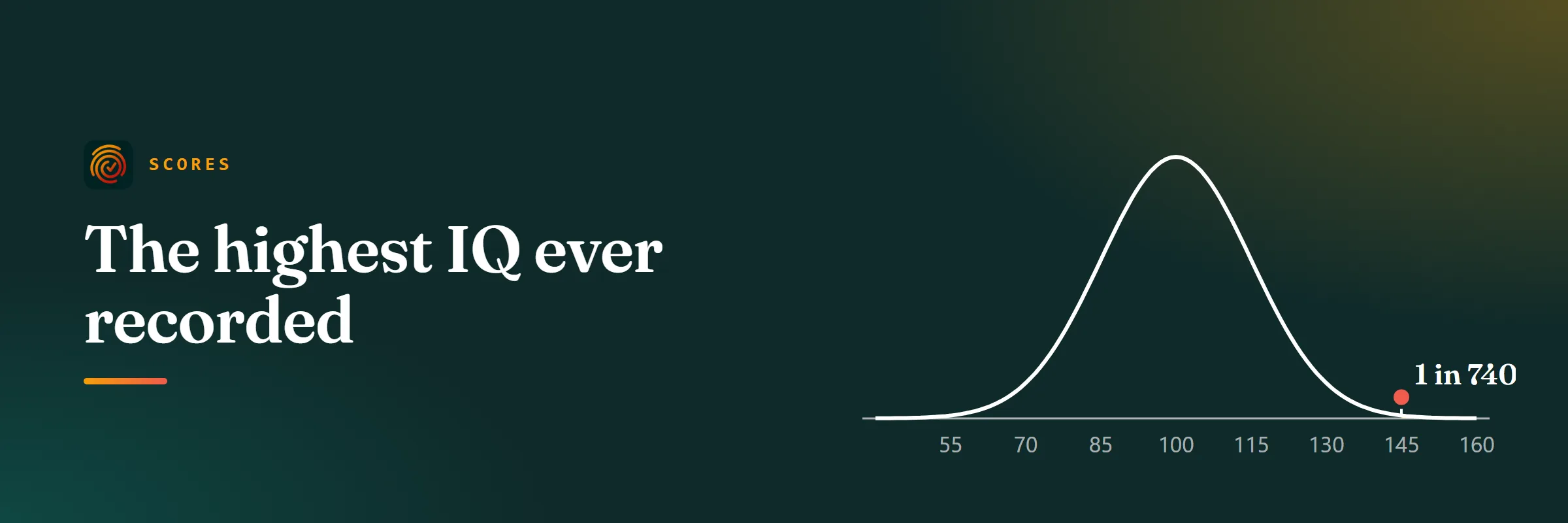
Search for the highest IQ ever and you will find numbers from 190 to 300. Almost none of them come from a modern, published test. This page lists the most cited names, says where each number comes from, and explains why the far end of the IQ scale cannot be measured precisely.
The most cited high IQ scores
These are the names that appear most often. The scores come from different tests, eras and methods, so they cannot be compared directly.
| Name | IQ cited | Where the number comes from |
|---|---|---|
| Marilyn vos Savant | 228 | Childhood test, ratio IQ; listed by Guinness 1986 to 1989 |
| Terence Tao | about 220 to 230 | Childhood estimate; no published test record |
| Christopher Hirata | about 225 | Childhood estimate |
| Kim Ung-yong | about 210 | Childhood figure listed by Guinness |
| Christopher Langan | about 195 to 210 | Reported in media; tests not published |
| William James Sidis | 250 to 300 | Guess made long after his death; never tested |
None of these scores comes from a published modern full-scale test. Treat them as reported figures.
Marilyn vos Savant and the Guinness record
Marilyn vos Savant, born in 1946, was listed in the Guinness Book of World Records under Highest IQ from 1986 to 1989. The 228 came from a test she took as a child, scored with the old ratio method: mental age divided by real age. She became widely known through her "Ask Marilyn" column in Parade magazine, especially in 1990, when she gave the correct answer to the Monty Hall probability puzzle and thousands of readers wrote in to say she was wrong.
Guinness later retired the Highest IQ category. Its reason was the one this page keeps returning to: at that height, tests do not agree with each other and cannot rank people reliably.
Terence Tao
Terence Tao, born in 1975, is one of the most celebrated mathematicians alive. He scored 760 on the mathematics section of the SAT at the age of eight, went to university as a child and won the Fields Medal in 2006. Figures of 220 to 230 are often attached to him, based on childhood testing, but no test record has been published. Tao himself has stressed hard work, good teachers and curiosity over any score.
William James Sidis
William James Sidis (1898 to 1944) entered Harvard at 11 and was famous as a child prodigy. The figures of 250 to 300 often quoted for him were written decades after his death and are guesses, not test results. His adult life, after years of press attention, was largely spent away from academic work, and he is often cited as a warning about pressure on gifted children.
Other names you will see
Kim Ung-yong, born in 1962 in South Korea, was listed by Guinness with an IQ of about 210 as a young child. Christopher Hirata, now an astrophysicist, is often cited at about 225 from childhood. Christopher Langan became known in the late 1990s through television and press stories that put his IQ at 195 to 210; those tests have not been published. Celebrity IQs, such as the 160 often given for Einstein or Hawking, are estimates with no test behind them.
Why "highest ever" cannot be measured
Modern tests give a deviation IQ: your rank compared with people of your age, with a mean of 100 and a standard deviation of 15. The WAIS-IV, the most used adult test, reports scores up to 160, its ceiling. Above that, there are simply too few people to build reliable norms. The numbers show why:
| IQ (standard scale) | How rare |
|---|---|
| 160 | 1 in 31,574 |
| 180 | 1 in 21 million |
| 200 | 1 in 76 billion |
| 228 | 1 in 141 quadrillion |
An IQ of 200 on today's scale would be about 1 in 76 billion people, more than everyone alive. Scores of 200 and above come from old childhood ratio tests, which spread out far more widely than modern scores, or from guesses. The ratio method is part of the history of how the average of 100 was set, and it was dropped for exactly this reason.
What a very high IQ does and does not mean
The people above show a pattern. Very high reasoning ability opened doors for Tao and vos Savant, while Sidis's and Langan's stories are about pressure, money and opportunity as much as ability. IQ predicts how quickly people learn complex material, but health, support, interest and luck shape what they do with it. Even at the level of high-IQ societies such as Mensa, members are a varied group, not a single type.
Frequently asked questions
Who has the highest IQ ever recorded?
Marilyn vos Savant held the Guinness record for Highest IQ from 1986 to 1989, with a childhood score of 228. Guinness later retired the category because tests cannot measure scores that high reliably, so there is no official record holder today.
What is Terence Tao's IQ?
Figures of about 220 to 230 are widely repeated, based on childhood testing, but no test record has been published. What is documented is his achievement: university mathematics as a child and a Fields Medal in 2006.
Is an IQ of 200 possible?
Not on a modern test. On today's scale, 200 would be about 1 in 76 billion people, more than all humans alive. Scores of 200 and above come from old childhood ratio tests or from estimates.
What is the highest score an IQ test can give?
The WAIS-IV reports full-scale scores up to 160. Most other standard tests have similar ceilings, because above that point there are too few people to measure against.
Was Einstein's IQ 160?
There is no record that Einstein ever took an IQ test. The 160 figure is a modern estimate, not a measured score.
Ready for the real thing?
32 puzzles, 25 minutes, your score and its range straight away.
Start the free test