

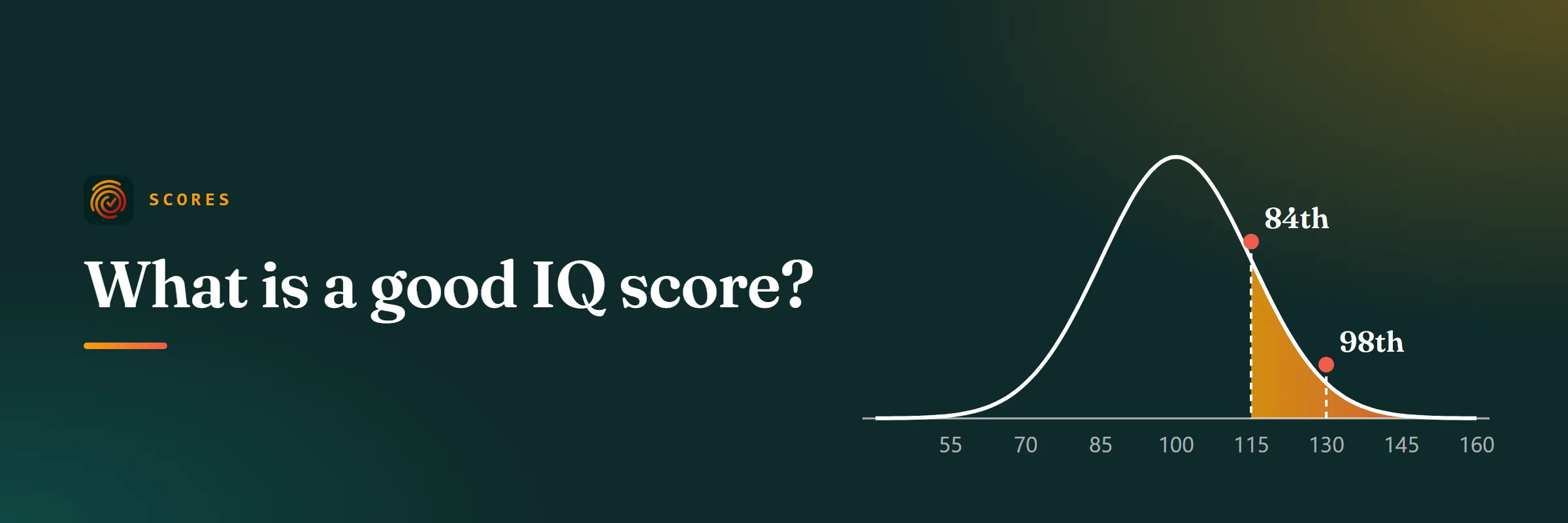
"Good" is the wrong word for an IQ score, but it is the question everyone asks after a test. A score only makes sense compared with other people, so the honest answer has two parts: where your number sits on the scale, and what you are comparing it for. This page covers both, range by range and score by score.
The short answer
IQ scores are set so that 100 is exactly the middle of the population. Anything above 100 is above average, and anything from about 110 upward is clearly above average. In plain terms:
- 100: exactly average, higher than half of people.
- 110: higher than about 75 in 100 people.
- 120: higher than about 91 in 100.
- 130: higher than about 98 in 100, the usual line for gifted programmes and Mensa.
A score of 95 or 105 is not meaningfully different from 100. Small differences are within the margin of error of any test.
Why "good" is relative
An IQ is a rank, not an amount. Modern tests compare you with a large sample of people your age and place you on a bell curve with a mean of 100 and a standard deviation of 15. Because the mean is fixed by design, the average IQ is 100 at every age, and a score tells you how many people you outperformed, not how much intelligence you have in any absolute sense.
About 68% of people score between 85 and 115, about 95% between 70 and 130, and only about 2% score above 130.
What each IQ range means
The level names come from the Wechsler scales, the most used clinical tests. Each range covers a slice of the bell curve:
| Score | Level | Share of people | What it means |
|---|---|---|---|
| 130 and above | Very Superior | 2.3% | The top 2 in 100. Usual line for Mensa and many gifted programmes. |
| 120 to 129 | Superior | 6.8% | Clearly above average; higher than about 91 in 100 at the bottom of the range. |
| 110 to 119 | High Average | 16.1% | Above the middle; higher than about three in four people. |
| 90 to 109 | Average | 49.5% | The middle half of the population. |
| 80 to 89 | Low Average | 16.1% | Below the middle but within the normal range. |
| 70 to 79 | Borderline | 6.8% | Below average; worth a closer look only if everyday life is also hard. |
| 69 and below | Extremely Low | 2.3% | One of two criteria for an intellectual disability; the other is real difficulty with everyday adaptive skills. |
The ranges are conventions, not hard lines: a 109 and a 111 reflect almost the same performance, even though they carry different labels.
What common IQ scores mean, score by score
Scores below 100
- 70: about the 2nd percentile, two standard deviations below the mean. On a clinical test, a score at or below about 70 is one of the criteria for an intellectual disability, but only together with real difficulty in everyday life.
- 75: about the 5th percentile, in the Borderline range. Many people here live and work independently; support at school or work can make a large difference.
- 80: about the 9th percentile, the bottom of Low Average. Learning complex new material may take longer, and practical, hands-on learning often works well.
- 85: the 16th percentile, one standard deviation below the mean and the lower edge of the middle two-thirds of people.
- 90: about the 25th percentile, the start of the Average range.
- 95: about the 37th percentile; on a single test, not meaningfully different from 100.
Scores from 100 upward
- 100: dead centre. Half of people score higher.
- 105: slightly above average, about the 63rd percentile; not a meaningful difference from 100 on a single test.
- 110: the start of High Average, about the 75th percentile.
- 115: one standard deviation above the mean, the 84th percentile, about 1 in 6 people.
- 120: the start of the Superior range, the 91st percentile, about 1 in 11.
- 125: the top 5%, about 1 in 21.
- 130: two standard deviations above the mean, the top 2%, about 1 in 44.
- 135: the top 1%, about 1 in 100.
- 140: about 1 in 260; once labelled "near genius" in old classifications.
- 145: three standard deviations above the mean, about 1 in 740.
- 150: about 1 in 2,300, near the ceiling of most tests.
- 160: about 1 in 31,600, the highest score the WAIS-IV reports.
IQ percentiles explained
A percentile tells you the share of people who score below you. If your IQ is at the 84th percentile, you scored higher than about 84 in 100 people. Percentiles are often easier to understand than IQ points, because the distance between percentiles shrinks near the middle and stretches at the ends: the 15 points from 100 to 115 cover 34% of people, while the 15 points from 130 to 145 cover about 2%.
| IQ | Percentile | How rare (this score or higher) |
|---|---|---|
| 100 | 50.0 | about 1 in 2 |
| 110 | 74.8 | about 1 in 4 |
| 115 | 84.1 | about 1 in 6 |
| 120 | 90.9 | about 1 in 11 |
| 125 | 95.2 | about 1 in 21 |
| 130 | 97.7 | about 1 in 44 |
| 135 | 99.0 | about 1 in 102 |
| 140 | 99.6 | about 1 in 261 |
| 145 | 99.9 | about 1 in 741 |
| 150 | 100.0 | about 1 in 2,331 |
Computed from the normal curve, mean 100, standard deviation 15.
How to read your own IQ score
- Find the scale. Almost all modern tests use a mean of 100 and a standard deviation of 15. Some older or society-specific tests use 16 or 24, which makes the same rank look like a bigger number: the top 2% is about 130 on a 15-point scale, but about 148 on the Cattell scale with 24.
- Turn it into a percentile. A percentile is easier to compare than a raw IQ. Use the table above, or the full chart, to see how many people in 100 you scored higher than.
- Widen it into a range. Add and subtract about 5 points for a clinical test, and more for a short online test. If the whole range sits in one level, that level describes you well; if it crosses two, both are plausible.
- Ask what you wanted it for. Curiosity, a school decision and a clinical question need very different levels of precision. Only the last two need a psychologist's test.
What counts as a good score for…
- Everyday life, school and work: any score in the average range or above is fully compatible with doing well. Most jobs have no IQ requirement at all, and effort, knowledge and skills matter far more day to day.
- Gifted programmes: many use about 130 as a guide, usually alongside school results and teacher input; some use 120 to 125 for broader enrichment programmes.
- Mensa: the top 2% on an approved, supervised test, about 130 on most modern tests. Online scores do not count, as our guide to qualifying for Mensa explains.
- Intellectual disability: an IQ of about 70 or below is one of two criteria; the other is real difficulty with everyday adaptive skills. A score alone is never enough.
An IQ score measures a narrow slice of ability
An IQ test samples a few kinds of reasoning, such as finding patterns, working with numbers, holding information in mind and, on clinical tests, vocabulary and processing speed. People who do well on one of these tend to do well on the others, which is why a single number is useful. But the test leaves out a great deal: practical skill, social understanding, creativity, musical or physical talent and specialist knowledge. A "good" IQ score is good at predicting performance on tasks like the ones in the test, and less informative about everything else.
What a high IQ predicts, and what it does not
IQ is one of the better single predictors of school grades and of how quickly people learn complex material at work. In research summaries the link with school grades is around 0.5: strong for a psychological measure, but it leaves most of the variation to other things.
A high score does not predict kindness, happiness, good judgement, creativity or persistence, and it does not guarantee success. Many people with average scores do very well, and many people with very high scores do not use them. Interest, effort, health, opportunity and luck shape outcomes at least as much as reasoning ability.
How much an IQ score can move
No test measures anyone exactly. Clinical tests report a confidence interval of roughly 5 points either side, so a measured 115 is best read as "probably between 110 and 120". Scores also move between sittings: tiredness, stress and familiarity with the tasks can shift a result by several points, and a second attempt on the same kind of test usually scores a little higher.
Scores in childhood can change noticeably over the years, while adult scores are more stable. If a single number matters, for example for a school placement, psychologists look at the range, the pattern of sub-scores and real-world evidence, not one result.
Why online IQ scores often look high
Many online tests produce flattering results. Some are not normed on a representative sample, some are scored generously to encourage sharing or sales, and the people who take them are not a random group: puzzle fans take more puzzle tests. Judging whether an online test is credible comes down to how it was built, scored and checked. Our own test shows every result with a 90% range, so you can see how precise it is.
Has a good score changed over time?
Yes, in raw terms. Through much of the twentieth century, raw scores on IQ tests rose by about three points per decade, a pattern called the Flynn effect. Test makers keep the average at 100 by renorming their tests, so the bar for a "good" score has quietly moved upward: a person who scored 115 against norms from the 1950s would score lower against today's norms. That is also why a score is only meaningful alongside the test and edition that produced it, and why old scores from decades-old tests should be read with care.
Scores above 160, and why 200 is not a real IQ
On today's scale, a score of 160 is about 1 in 31,600 people, and 200 would be about 1 in 76 billion, more than everyone alive. Numbers above 160 usually come from old childhood ratio tests or from estimates, which is why the famous claims of the highest IQs are so disputed. A test that tells you your IQ is 190 is not measuring on the standard scale.
What a lower score does and does not mean
A score below 100 is not a verdict. Low Average, from 80 to 89, is within the normal range, and many people there do well at school and work, especially in roles that reward experience, practical skill and reliability. A single low result can also reflect a bad day, test anxiety, a language barrier or an unfamiliar format.
If a score below about 80 matches real, ongoing difficulties in learning or daily life, a full assessment by a psychologist can identify what would help. If it does not match everyday life, the test result is the thing to question.
How to use your score
- If you were curious, read the level and the percentile, and leave it there; the number does not need to change any plan.
- If your score is high and you want it confirmed, a supervised test is the only route to an official result, for example for Mensa or a gifted programme.
- If your score surprised you, consider the conditions: tiredness, distraction, a rushed attempt or an unfamiliar format all lower results. A calm retake on a different day is a fair check.
- If you want to improve at reasoning tasks, practising the formats helps a little and good sleep helps more; lasting gains in general ability are small, so focus on skills and knowledge for the things you actually want to do.
Frequently asked questions
What is a good IQ score?
Any score above 100 is above average. Scores from 110 to 119 are High Average, 120 to 129 Superior, and 130 or more Very Superior, reached by about 2 in 100 people. What counts as good depends on what you compare it with.
Is 110 a good IQ?
Yes. 110 is the start of the High Average range and higher than about 75 in 100 people.
Is 115 a high IQ?
It is clearly above average: 115 is one standard deviation above the mean and higher than about 84 in 100 people, roughly 1 in 6. It sits in the High Average range. It is not in the gifted range most programmes use, which starts around 130, but it is a strong result on any well-built test.
Is 120 a good IQ score?
Yes. 120 is the start of the Superior range and higher than about 91 in 100 people; about 1 in 11 people score 120 or more.
What IQ is considered gifted?
Most gifted programmes use about 130, the top 2%, often together with school achievement and teacher input. Some programmes use lower or higher cut-offs.
What IQ do you need for Mensa?
Mensa admits people in the top 2% on an approved, supervised test, which is about 130 on most modern tests.
Is 100 a bad IQ?
No. 100 is exactly average: half of people score higher and half lower. It is fully compatible with success at school and work.
What is a genius IQ?
There is no official genius score. Older classifications used 140 as a 'genius' line, but modern tests simply call 130 and above Very Superior.
Why is my online IQ score higher than expected?
Many online tests are not normed on a fair sample, some round up to please, and people who enjoy puzzles take them more often. Treat an online score as an estimate with a range.
Ready for the real thing?
32 puzzles, 25 minutes, your score and its range straight away.
Start the free test