

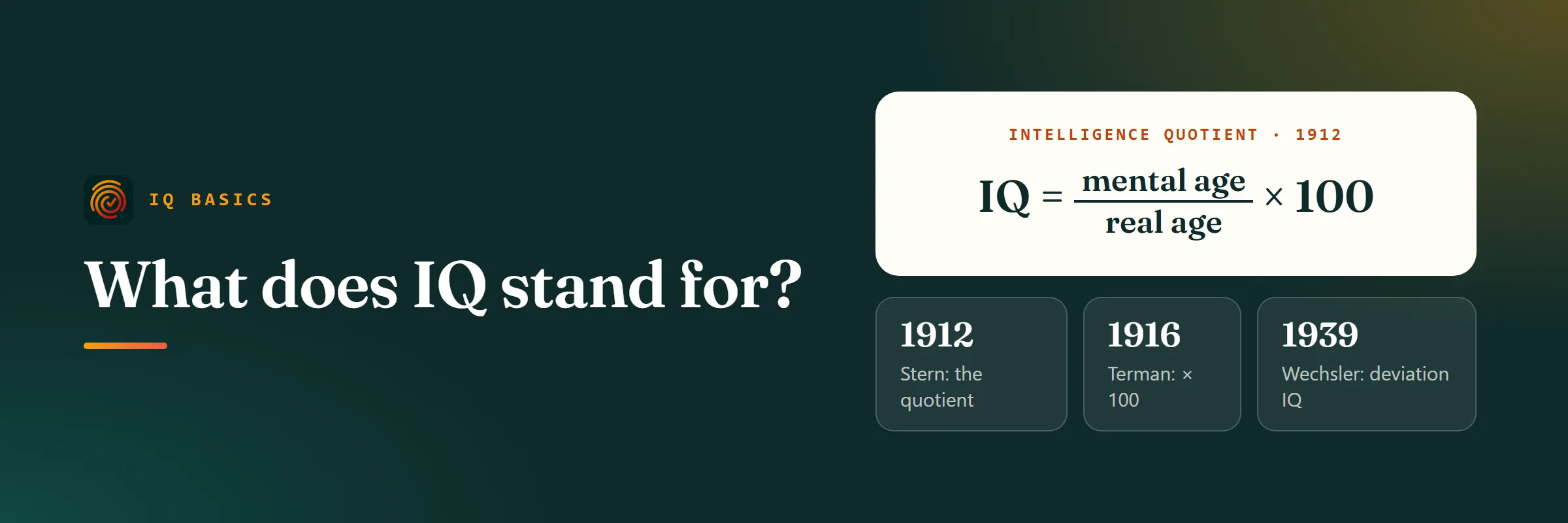
IQ is short for intelligence quotient, a score from a standardised test of reasoning. The word "quotient" is a clue to the history: the first IQ scores were calculated by division. Today's scores are worked out differently, but the name stuck. Here is where the term came from, how the meaning changed, and what an IQ score actually measures now.
IQ stands for intelligence quotient
A quotient is the result of dividing one number by another. The German psychologist William Stern proposed the term Intelligenzquotient in 1912 for a simple idea: compare how a child performs on a test with how children of different ages usually perform, and express it as one number. The English translation, intelligence quotient, was shortened to IQ and spread quickly through American testing.
Why it was called a quotient
The first practical intelligence test, published in 1905 by Alfred Binet and Théodore Simon in France, gave children a "mental age": the age group whose typical performance matched theirs. Stern divided mental age by real age. In 1916, Lewis Terman at Stanford multiplied the result by 100 to remove the decimals, which is why an exactly average score is 100.
| Real age | Mental age | Ratio IQ |
|---|---|---|
| 10 | 10 | 10 ÷ 10 × 100 = 100 |
| 10 | 12 | 12 ÷ 10 × 100 = 120 |
| 10 | 8 | 8 ÷ 10 × 100 = 80 |
| 8 | 12 | 12 ÷ 8 × 100 = 150 |
This ratio IQ worked reasonably for children, whose abilities grow year by year, but it broke down for adults: mental age stops climbing in early adulthood while real age keeps rising, so the formula made everyone look less able as they got older. Ratio scores for very young children also spread far wider than modern scores, which is where many of the famous claims of IQs above 200 come from.
Why the name no longer fits
In 1939 David Wechsler, a psychologist at Bellevue Hospital in New York, published the Wechsler-Bellevue scale with a new method: the deviation IQ. Instead of dividing ages, it compares your score with people of your own age and places you on a bell curve, with 100 as the mean and 15 points as one standard deviation. His adult test became the Wechsler Adult Intelligence Scale (WAIS) in 1955, and almost every major test now uses the same method.
So a modern IQ is no longer a quotient at all. It is a rank: an IQ of 115 means you scored higher than about 84 in 100 people your age. The method is also why the average IQ is 100 at every age. Psychologists kept the familiar name because the scale looked the same as before.
What an IQ score measures today
Modern tests combine several kinds of task, such as vocabulary, matrix reasoning, block design, digit span and symbol coding. People who do well on one tend to do well on the others, a finding first described by Charles Spearman in 1904 and called general intelligence, or g. Today's tests are built on the Cattell-Horn-Carroll model, which places g at the top and broad abilities beneath it:
- Fluid reasoning: solving new problems, such as matrix puzzles.
- Crystallised knowledge: vocabulary and learned information.
- Working memory: holding and using information in mind.
- Processing speed: doing simple tasks quickly and accurately.
- Visual-spatial reasoning: picturing and turning shapes in your mind.
The full-scale IQ sums these up in one number, and the levels from Extremely Low to Very Superior describe where a score sits on the scale.
How an IQ is measured today
A clinical IQ test is given one to one by a trained examiner and takes around an hour or more. Each subtest produces a raw score, such as the number of puzzles solved, which is converted using norms: tables built by testing a large sample of people chosen to match the population by age, sex, region and education. Those tables turn your raw score into a rank within your age group, and the ranks combine into index scores and a full-scale IQ.
Because the tables come from a real sample, they age. Test makers collect new norms every decade or two, which is why a score from a 1990s edition and a score from today's edition are not directly comparable.
Online tests and the meaning of IQ
Many websites use the word IQ for any score on a puzzle test. A true IQ needs norms from a representative sample and controlled conditions, which unsupervised online tests cannot fully provide. A careful online test can still give a useful estimate, but the accuracy of an online score depends on how it was built and scored, and the result is best read as a range rather than a single number.
What IQ does not measure
An IQ score says nothing direct about creativity, practical judgement, emotional understanding, motivation or character. It also reflects test conditions: sleep, stress, language and familiarity with the tasks can move a score by several points. That is why psychologists report IQ with a margin of error and never treat it as a full description of a person.
A short timeline of the IQ
- 1904: Charles Spearman describes general intelligence, g.
- 1905: Binet and Simon publish the first practical intelligence test in France.
- 1912: William Stern proposes the intelligence quotient: mental age divided by real age.
- 1916: Lewis Terman publishes the Stanford-Binet and multiplies the quotient by 100.
- 1917: The US Army Alpha and Beta tests become the first mass group intelligence tests.
- 1939: David Wechsler introduces the deviation IQ with the Wechsler-Bellevue scale.
- 1949 and 1955: The WISC for children and the WAIS for adults appear; both are still revised today.
The darker side of IQ history
Binet saw his test as a way to find children who needed help, and he warned against treating it as a fixed measure of worth. Others did not share his caution. In the early twentieth century, test results were misused to support eugenic policies, including forced sterilisation laws in parts of the United States and arguments for restricting immigration. Modern testing standards, with careful norms and limits on interpretation, grew partly out of that history.
Frequently asked questions
What does IQ stand for?
IQ stands for intelligence quotient. The term comes from the German Intelligenzquotient, proposed by the psychologist William Stern in 1912.
Why is it called a quotient?
Early IQ scores really were a quotient: a child's mental age divided by their actual age. Lewis Terman multiplied the result by 100 in 1916, which is why an exactly average score is 100.
Who invented the IQ test?
Alfred Binet and Théodore Simon published the first practical intelligence test in France in 1905. William Stern named the intelligence quotient in 1912, Lewis Terman created the Stanford-Binet in 1916, and David Wechsler introduced the modern scoring method in 1939.
Is IQ still calculated as a quotient?
No. Modern tests use a deviation IQ: your score shows how far you sit from the average of people your age, with 100 as the mean and 15 points as one standard deviation. The old name stayed.
What does an IQ of 100 mean?
It means exactly average for your age: about half of people score higher and half lower. About two in three people score between 85 and 115.
What is the difference between IQ and EQ?
IQ refers to reasoning ability measured by standardised tests. EQ, or emotional intelligence, is a separate idea about perceiving and managing emotions; the name borrows the 'quotient' label but it is measured in different ways.
Is your IQ fixed for life?
Not completely. Scores are fairly stable in adulthood, but they can change noticeably during childhood, and schooling, health and test conditions can move a result by several points.
Ready for the real thing?
32 puzzles, 25 minutes, your score and its range straight away.
Start the free test