

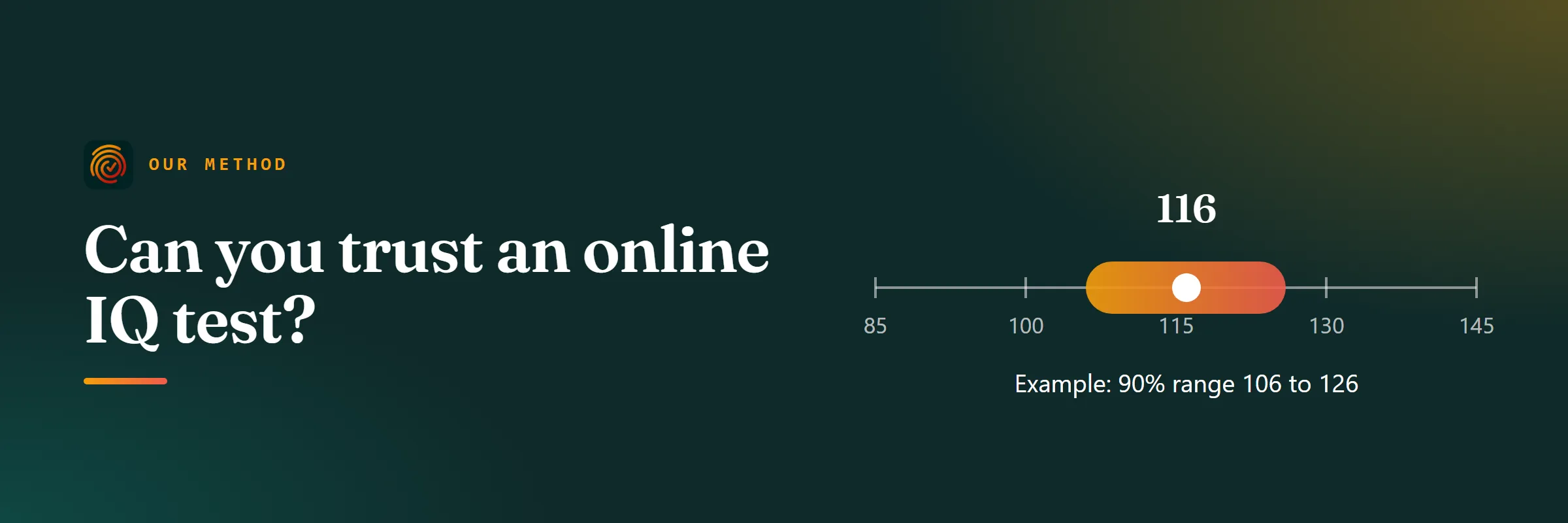
Some online IQ tests give a fair estimate of your reasoning ability. None of them gives a clinical IQ. The useful question is not "is it real?" but "how much trust can this particular number carry, and for what?"
Can you trust an online IQ test? The short answer
You can trust a well-built online test to place you in roughly the right part of the IQ scale. You cannot trust it for a diagnosis, a school placement, a job decision or entry to a high-IQ society. Those need a supervised test given by a trained professional.
Within that limit, quality varies a great deal. A careful test uses many puzzles of graded difficulty, scores them against a fixed scale and tells you how wide the uncertainty is. A careless one asks a dozen trivia-style questions, hands out flattering numbers and then charges you to see them. The rest of this guide shows how to tell the two apart.
Accuracy, reliability and validity: three different questions
People ask whether a test is "accurate", but psychologists split that into three separate checks. A test can pass one and fail another.
- Reliability asks whether the test gives the same answer twice. If you took it on two calm days, would your scores be close? Short tests are less reliable, because each lucky or unlucky guess moves the score more.
- Validity asks whether the test measures what it claims to. A reasoning test is valid if its scores track other good measures of reasoning, such as a full clinical assessment. A quiz about general knowledge may be reliable and still not measure reasoning at all.
- Norms decide what the score means. An IQ compares you with a reference group, so a score of 100 is only meaningful if the reference group matches the population. A test normed on its own enthusiastic visitors will place most people too high or too low.
When a site says its test is accurate, ask which of the three it means, and what evidence it shows.
How do online IQ tests work?
Most online IQ tests are built from the same families of puzzle that appear in research tests: pattern matrices, number and letter series, and shape rotation. These puzzles test reasoning rather than knowledge, which makes them easy to score automatically and hard to study for.
The difference between tests lies in what happens after you answer. The simplest tests count your correct answers and map the count to an IQ through a fixed table. Better tests weight each puzzle by its difficulty, use enough puzzles at each level to separate high scorers from average ones, and report how uncertain the final number is.
Our own test uses 32 puzzles across four kinds of reasoning and four difficulty levels, with a 25-minute limit. Every generated puzzle is checked by code to have exactly one answer that fits the rule. The full method, including the provisional status of our difficulty values, is set out on the page about how our test is built and scored.
How does an online test differ from a psychologist's assessment?
A clinical IQ comes from a test such as the WAIS-IV for adults, the WISC-V for children or the Stanford-Binet, given one to one by a trained examiner. The session usually takes an hour or more. It gives four things no website can.
- Controlled conditions. The examiner sets the room, the timing and the instructions, and notices tiredness, anxiety or misunderstanding.
- Large, matched norms. The test makers gave the test to a large sample matched to the population by age, sex, region and education, so a score of 100 really is the middle for your age group.
- A full profile. Clinical tests measure verbal comprehension, working memory and processing speed as well as reasoning, and report each index separately.
- Professional interpretation. A psychologist reads the scores alongside your history, which is what makes them usable for a diagnosis or a support plan.
An online test has none of these controls. You choose when and where to take it, nobody checks the conditions, and you can take it again. That does not make the result worthless. It makes it an estimate, and it should be labelled as one.
Which IQ tests do psychologists use?
A handful of tests make up almost all clinical IQ testing. Each is sold only to qualified professionals, which is one reason none of them can be taken online.
- WAIS-IV (Wechsler Adult Intelligence Scale) is the standard adult test, for ages 16 to 90. It reports a full-scale IQ and four indexes: verbal comprehension, perceptual reasoning, working memory and processing speed.
- WISC-V (Wechsler Intelligence Scale for Children) covers ages 6 to 16 and is the test most schools and educational psychologists rely on.
- Stanford-Binet Fifth Edition runs from age 2 to 85 and over. It measures five factors, each with a verbal and a nonverbal half, and reaches further into very high and very low scores than most tests.
- Raven's Progressive Matrices is a nonverbal test of pattern reasoning, often used in research and where language would get in the way.
All of these use the same scale as an online estimate: a mean of 100 and a standard deviation of 15. That shared scale is what lets you compare an online result with a clinical one, as long as you remember which of the two carries the error bars.
Each of these tests was normed on thousands of people chosen to match the population, and the norms are renewed every decade or two because average raw scores drift over time. No online test you can take for free has that kind of norming behind it, which is the main reason its number should be read as an estimate.
Why every IQ score is a range, not a point
No test measures ability exactly. Even clinical tests report a confidence interval, typically around 5 points either side of the score. A measured IQ of 118 is best read as "probably between 113 and 123".
Short tests have wider ranges, because each answer carries more weight. That is why our free result shows a 90% range next to the score: if 100 people with your exact answers took a much longer test, about 90 of them would land inside it. The range is honest about the uncertainty instead of hiding it behind a precise-looking number.
The range matters most near a cut-off. A score of 128 and a score of 131 sit either side of the line many gifted programmes use, yet their ranges overlap almost completely. For a decision that turns on a few points, only a clinical test is good enough. For a general sense of where you stand on the IQ score ranges, an estimate with its range is fine.
Why do online IQ scores often run high?
If your online result came out higher than you expected, one of these is usually the reason.
- Practice. Scores rise on a second attempt, and on a tenth, because the puzzle formats become familiar. Count your first calm attempt.
- Short tests with low ceilings. With few hard puzzles, a test cannot tell a good score from a very good one, and generous tables tend to round up.
- Self-selection. People who enjoy puzzles take more puzzle tests. If a site builds its norms from its own visitors, average visitors look below average and everyone's score shifts.
- Commercial pressure. A flattering number sells certificates. A site that charges before it shows any score has a reason to make the score feel worth buying.
Because of these effects, the right question about any score is not whether it is a good IQ score but whether the test that produced it earned your trust.
How to tell a credible online IQ test from a flattering one
Run any test through these checks before you believe its number.
- Does it test reasoning, not trivia? Pattern, series and rotation puzzles measure reasoning. Questions about capitals or spelling measure knowledge.
- Is it long enough? A quiz of 10 or 15 items cannot spread scores across the scale with any confidence.
- Does it show a range? A single number without any uncertainty is a sign that nobody has thought about error.
- Does it explain its scoring? A credible test says how it turns answers into an IQ and what its norms are based on.
- Does it show the score before asking for money? A paywall in front of the result is a sales funnel, not a test design.
- Does it admit its limits? Honest tests say plainly that they are not a clinical assessment.
How to get the most from a free test
The conditions you create decide how much your result is worth.
- Choose a time when you are rested, not late at night or straight after work.
- Find a quiet place, mute notifications and close other tabs.
- Give every puzzle a real attempt, and guess when time is short; a blank never scores.
- Count your first attempt. A retake shows what familiarity adds, not what your ability is.
Working through IQ practice puzzles with worked answers before a test will lift your score a little, so treat a post-practice result as slightly generous.
When do you need a clinical assessment instead?
See a qualified psychologist rather than relying on any online score when:
- a diagnosis is involved, such as a learning disability or an intellectual disability;
- a school or university needs evidence for support, gifted placement or exam access arrangements;
- a legal, medical or employment decision depends on the result;
- you want to join a society such as Mensa, which accepts only supervised tests;
- your result is very far from what you expected and it worries you.
A clinical assessment costs money and time, but it is the only route to a score that others will accept.
How far can you trust our test?
We would rather you trusted our number the right amount than too much. Our test is built from reasoning puzzles only, uses 32 items across four difficulty levels, shows a 90% range next to every score and shows the full free result without a paywall. Its difficulty values are provisional: they will be refitted on real results, and the date and sample size will be published when that happens.
Read your result as a careful estimate. It can tell you roughly where you stand and which kinds of reasoning come most easily to you. It cannot replace a psychologist, and it does not try to.
Frequently asked questions
Are free online IQ tests accurate?
Some are accurate enough to place you in the right part of the IQ scale. None is accurate enough to give a clinical score. Look for a test that shows a range, explains its scoring and does not wait to sell you the number.
Why did I score higher online than on a real IQ test?
Online tests are usually shorter, unsupervised and easy to retake, and some sites score generously. Practice with the puzzle types also lifts a result by a few points. A supervised clinical test controls all of these.
Can an online IQ test be used for Mensa?
No. Mensa accepts a score only from a supervised test it runs itself or from an approved test given by a qualified professional. An online result can tell you whether trying is worth it, nothing more.
How many questions does a reliable IQ test need?
There is no single number, but very short quizzes of ten or fifteen items cannot separate scores well. More items and items of graded difficulty narrow the range around a score.
Is it worth paying for an online IQ test?
Pay only for something you can see before you buy, such as a sample report. A payment does not make the number more accurate. Accuracy comes from the test design, not the price.
Ready for the real thing?
32 puzzles, 25 minutes, your score and its range straight away.
Start the free test