

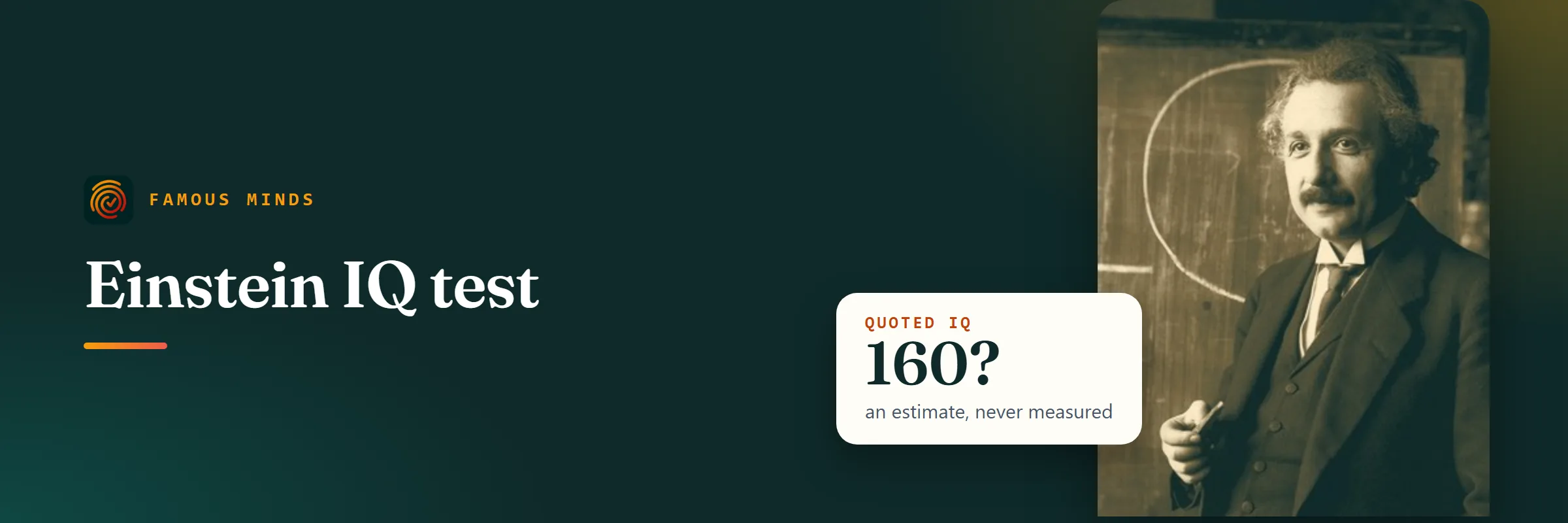
Albert Einstein's name has become shorthand for genius, and his IQ is quoted everywhere as 160. The test above lets you measure your own reasoning on the same scale used for that number. The rest of this page covers what is actually known about Einstein's mind, and why his famous score is a guess.
What this Einstein IQ test measures
Einstein described his thinking as working with images and rules rather than words. The test reflects that. Its 32 puzzles cover four kinds of reasoning: pattern matrices, where you find the rules running through a grid of shapes; number series; letter series; and mental rotation, where you turn a shape in your mind. The puzzles start easy and add one rule at each level, and your score comes with a 90% range, because no short test can be exact.
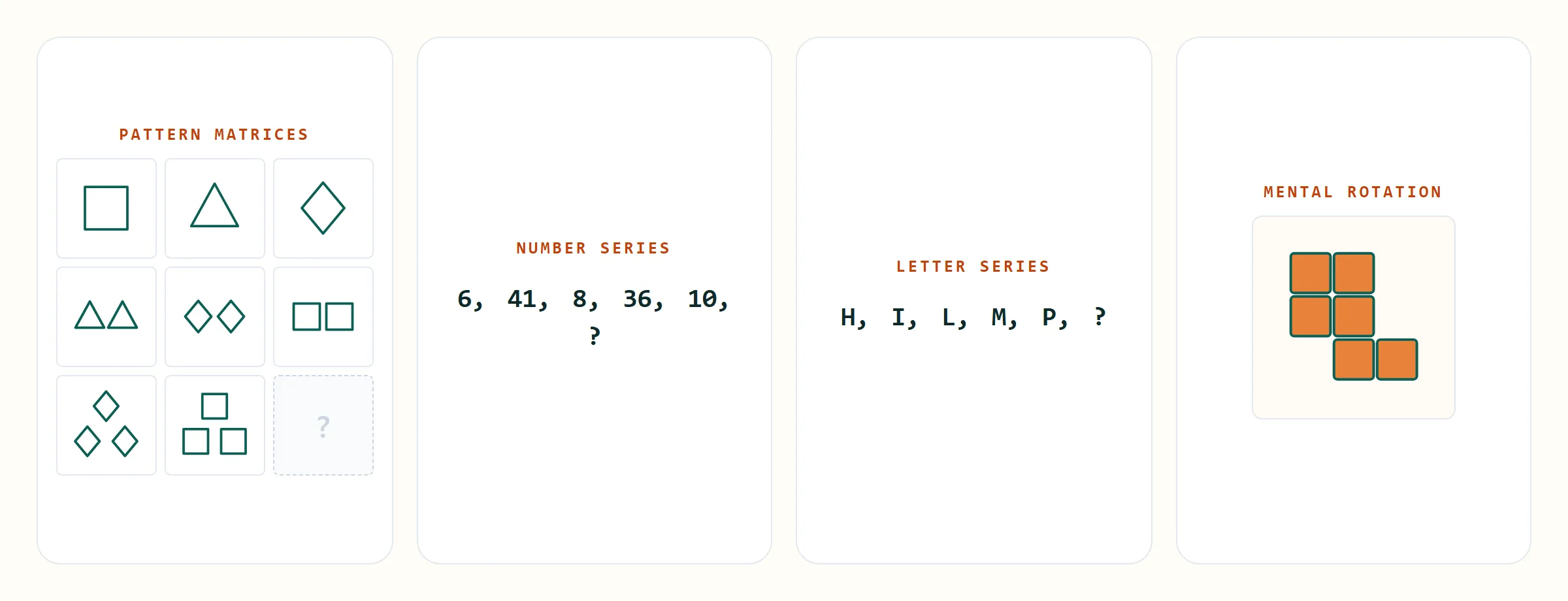
There are no maths formulas, physics questions or trivia. A test of knowledge would measure what you have learned, not how you reason, and Einstein himself valued imagination above knowledge.
Did Einstein ever take an IQ test?
There is no record that he did. Einstein was born in 1879 in Ulm, Germany, and finished school long before intelligence tests were common for adults. The first practical intelligence test was published in 1905, the same year Einstein published four landmark papers, but it was designed to assess schoolchildren. Adult IQ tests only arrived with the Wechsler-Bellevue scale in 1939, when he was 60 and living in Princeton. No IQ result for Einstein has ever been published.
Where the Einstein IQ of 160 comes from
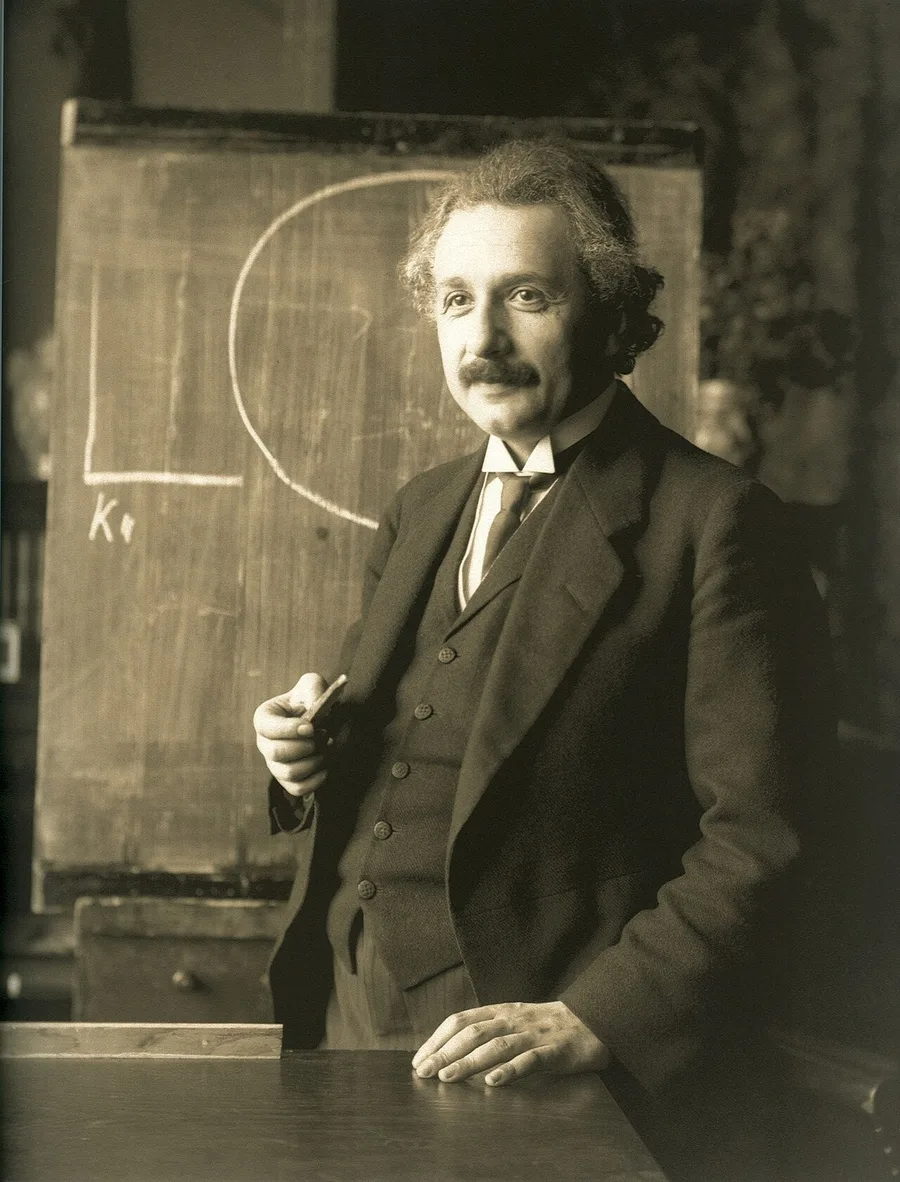
The figure of 160 appears in books, articles and countless websites, usually without a source. It is an estimate based on his achievements, not a measurement. It is also a convenient number: it sits at the very top of the modern adult scale, where an IQ of 160 is reached by about 1 in 31,574 people.
The same pattern applies to most celebrity IQs. As with other famous claims about the highest IQs, the number tells you how impressive the person seemed, not how they scored on a test.
What we actually know about Einstein's mind
A visual thinker
Einstein said that words played little part in his thinking, and that he worked with images and "combinatory play". At 16 he imagined chasing a beam of light, a thought experiment that fed into his theory of special relativity. That kind of spatial, rule-finding thinking is close to what reasoning tests measure.
A late talker, not a poor student
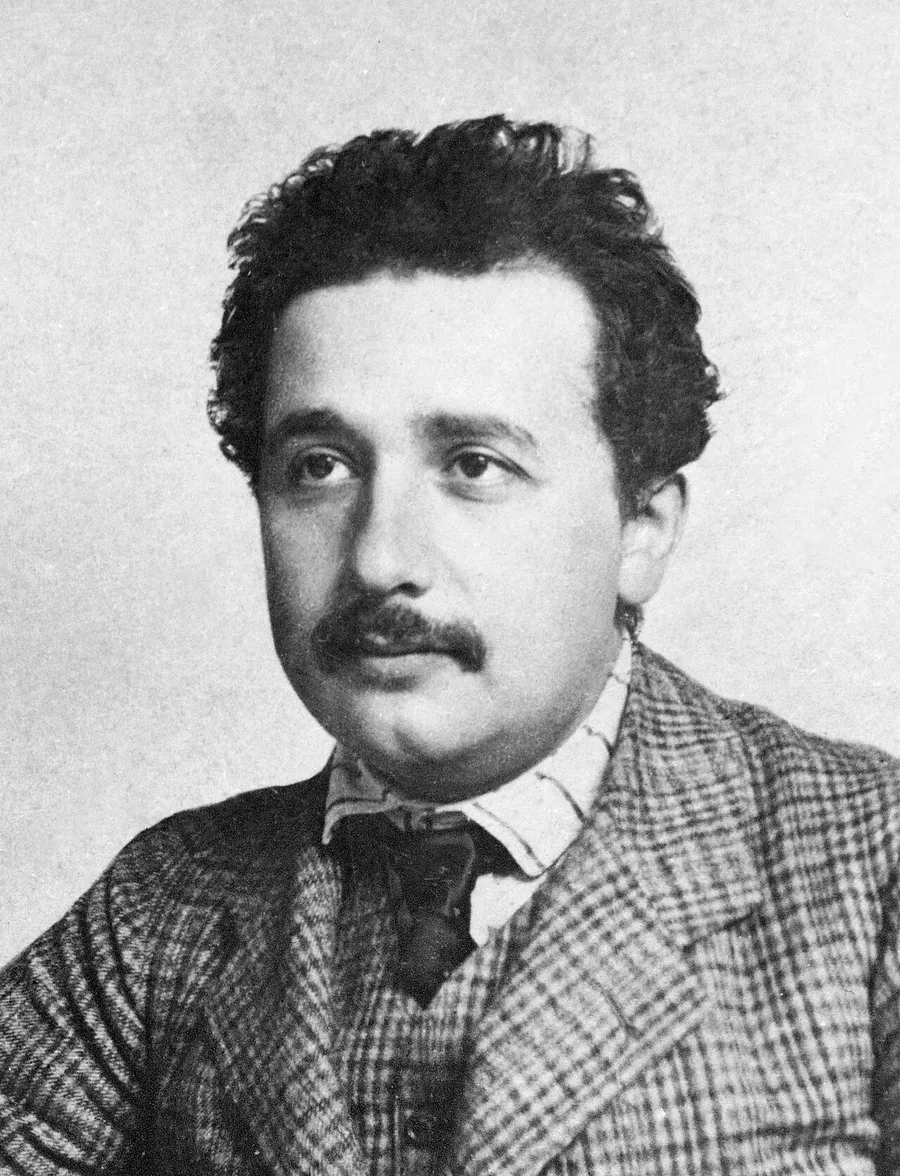
Family accounts say he was slow to start speaking as a toddler. The popular story that he failed mathematics is a myth: he was strong in maths and physics, and at 16 he failed the general part of the entrance exam to the Zurich Polytechnic while scoring well in the science sections. He passed a year later.
Achievements that made his name
In 1905, while working at the patent office in Bern, he published papers on the photoelectric effect, Brownian motion and special relativity, including the equation E = mc². He received the 1921 Nobel Prize in Physics for his work on the photoelectric effect.
His brain, studied
After his death in 1955, the pathologist Thomas Harvey removed and preserved Einstein's brain. A 1999 study in The Lancet reported unusual features in the parietal lobes, areas linked to spatial and mathematical thinking. One brain is a sample of one, though, so researchers caution against reading too much into it.
Why most online Einstein quizzes are not IQ tests
Many quizzes that use his name mix arithmetic, vocabulary, true-or-false statements and trick pictures. Those measure school knowledge and attention to detail, and their scores are rarely placed on a real scale. A reasoning test needs three things that quick quizzes skip:
- Puzzles with one defensible answer. Every puzzle in our test is checked by code so that exactly one of its six options fits the rules.
- Rising difficulty. Easy items only show who is below average; harder items are what separate high scores.
- A real scale. Your number correct is placed on the standard IQ scale and shown with a likely range, instead of a flattering label.
What his story says about IQ
His achievements came from reasoning ability combined with curiosity, persistence, freedom to think and decades of work. An IQ score captures only the first of those. Many people with very high scores never do anything remarkable, and some major discoveries came from people who would not have stood out on a test. If your result is lower than you hoped, it measures how you reasoned on these puzzles today, not what you can achieve.
The IQ scale at a glance
| Score | Level | About how many people |
|---|---|---|
| 130 and above | Very Superior | 2 in 100 |
| 120 to 129 | Superior | 7 in 100 |
| 110 to 119 | High Average | 16 in 100 |
| 90 to 109 | Average | 50 in 100 |
| 80 to 89 | Low Average | 16 in 100 |
| 79 and below | Borderline and below | 9 in 100 |
Level names follow the Wechsler scales; shares are rounded from the normal curve, with a mean of 100 and a standard deviation of 15.
How to read your result
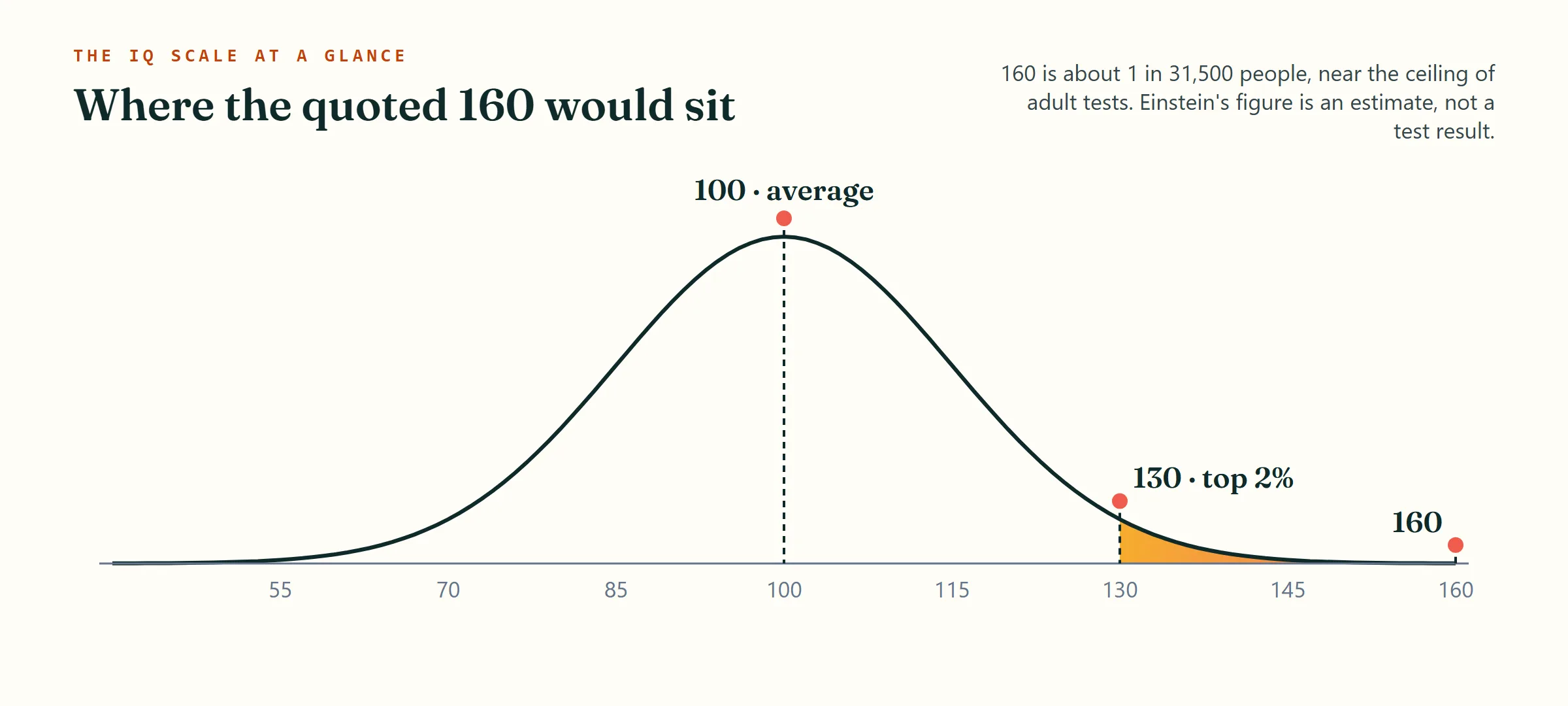
Your score is placed on the standard scale, where the average is 100 and 15 points is one standard deviation. About two in three people score between 85 and 115, about 1 in 44 reaches 130, and 160 is about 1 in 31,574. Online tests have wider error margins than a psychologist's test, which is why yours comes with a range.
Frequently asked questions
What was Albert Einstein's IQ?
Nobody knows. There is no record that Einstein ever took an IQ test. The 160 often quoted is a modern estimate, not a measured score.
Did Einstein ever take an IQ test?
Not as far as any record shows. Modern IQ tests for adults only arrived in 1939, when Einstein was 60 and already world famous, and no result for him has ever been published.
Where does the Einstein IQ of 160 come from?
It is an estimate repeated by writers and websites. 160 happens to be a round, very high number near the ceiling of modern adult tests, which makes it easy to quote but not evidence of a real score.
Is this a real Einstein IQ test?
It is not a test Einstein took; no such test exists. It is our free reasoning test with 32 puzzles and a 25-minute limit, scored on the standard IQ scale, with an Einstein theme because his thinking was so visual and rule-based.
How rare is an IQ of 160?
On the standard scale, about 1 in 31,600 people score 160 or higher. It is also the highest full-scale score the WAIS-IV adult test reports.
What score would match the famous Einstein figure?
If you take the popular estimate of 160 at face value, you would need to score higher than about 99.997% of people, roughly 1 in 31,600. Our test reports results up to 145 and shows anything beyond that as 145+, because short online tests cannot measure that height reliably.
Did Einstein fail maths at school?
No. This is a myth. He excelled at mathematics and physics; at 16 he failed the general part of the entrance exam to the Zurich Polytechnic, while doing very well in the science sections.
Ready to test your reasoning?
32 puzzles, 25 minutes, your score and its range straight away.
Take the Einstein IQ test