

The Stanford-Binet is the oldest family of IQ tests still in use. It descends directly from the first intelligence test ever published, and its 1916 American edition popularised the term IQ. This guide explains what the current edition measures, how it is given and scored, how it compares with the Wechsler tests, and what the name means when you see it attached to an online quiz.
What is the Stanford-Binet?
The Stanford-Binet Intelligence Scales are an individually administered, norm-referenced intelligence test. "Individually administered" means a trained examiner sits with one person and gives each task; "norm-referenced" means the results are compared with a large sample of people of the same age. The current version, the fifth edition (SB5), was written by Gale Roid and published in 2003.
The SB5 produces a full-scale IQ plus a verbal IQ, a nonverbal IQ, an abbreviated IQ and five factor scores. All of them use the familiar scale, where 100 is the mean and 15 points is one standard deviation, so a full-scale score of 115 is higher than about 84 in 100 people of the same age.
A short history of the Stanford-Binet
| Year | Edition | What changed |
|---|---|---|
| 1905 | Binet-Simon scale | Alfred Binet and Théodore Simon publish the first practical intelligence test in France. |
| 1916 | Stanford-Binet | Lewis Terman at Stanford adapts it for American children and reports scores as a ratio IQ: mental age divided by age, times 100. |
| 1937 | Forms L and M | Terman and Maud Merrill publish two parallel forms with a larger sample. |
| 1960 | Form L-M | The forms are combined, and the deviation IQ replaces the ratio IQ. |
| 1986 | Fourth Edition (SB4) | A new structure of area scores; the standard deviation is 16. |
| 2003 | Fifth Edition (SB5) | Gale Roid's revision: five factors, verbal and nonverbal halves, standard deviation 15. |
Two of those changes still matter when people compare scores. The 1916 edition reported a ratio IQ, the original intelligence quotient, which spreads out very widely for young children. And the fourth edition used a standard deviation of 16 rather than 15, so its numbers run slightly higher than today's for the same rank.
What the SB5 measures
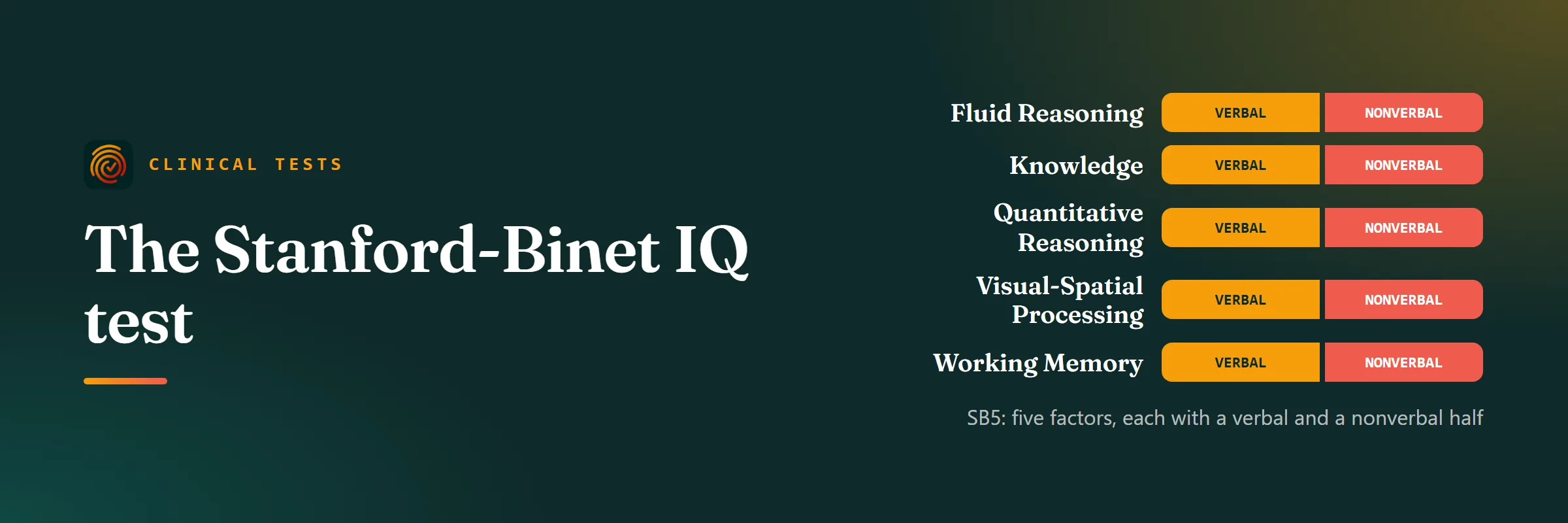
The SB5 is built on the Cattell-Horn-Carroll model of intelligence. It measures five broad factors, and each factor is tested twice: once with verbal tasks and once with nonverbal tasks that need little or no spoken language. That gives ten subtests in total.
| Factor | What it covers | Tested by |
|---|---|---|
| Fluid Reasoning | Solving new problems by finding patterns and rules | Nonverbal and verbal subtest |
| Knowledge | Information and vocabulary built up over time | Nonverbal and verbal subtest |
| Quantitative Reasoning | Working with numbers and numerical problems | Nonverbal and verbal subtest |
| Visual-Spatial Processing | Seeing patterns, relationships and positions in space | Nonverbal and verbal subtest |
| Working Memory | Holding and changing information in short-term memory | Nonverbal and verbal subtest |
The nonverbal half is one of the test's main strengths. People who are deaf or hard of hearing, people with limited English and some autistic people can show their reasoning without depending on speech.
How the Stanford-Binet is given
Testing starts with two routing subtests: nonverbal fluid reasoning (object series and matrices) and verbal knowledge (vocabulary). Performance on these sets the starting level for the remaining subtests, so a bright six-year-old and a struggling adult each begin at a point that fits them. This adaptive start keeps the test shorter and less frustrating.
A full battery usually takes about an hour, more for some people and less for others. The two routing subtests together form the abbreviated IQ, a quick estimate used for screening. The examiner records answers, times some tasks and notes behaviour such as attention and effort, which can matter as much as the numbers when interpreting results.
The test materials, which include toys, blocks, picture books and record forms, are sold only to qualified professionals, usually psychologists or specially trained educational professionals.
What the scores mean
Each composite score, including the full-scale IQ, uses a mean of 100 and a standard deviation of 15; each subtest uses a scaled score with a mean of 10 and a standard deviation of 3. Reports usually give percentile ranks and confidence intervals alongside the numbers, because every score carries some measurement error.
The bands are read the same way as on other modern tests: 90 to 109 is the middle of the range, about 2 in 100 people score 130 or above, and about 2 in 100 score below 70. The full IQ range chart lists every level with its percentile.
A feature that sets the SB5 apart is the extended IQ. Standard scores run from 40 to 160, but for people at the extremes the SB5 can estimate scores beyond that range, which is useful for very gifted children and for people with significant intellectual disability.
Reading the score profile
The full-scale IQ is the headline, but psychologists spend as much time on the pattern behind it. Three comparisons come up most often:
- Verbal against nonverbal IQ. A large gap can point to a language difficulty, a hearing problem, limited English or, in the other direction, strong verbal knowledge built through reading. It is a prompt for questions, not a diagnosis.
- Factor against factor. A working memory score well below the other factors is a common finding in attention and learning difficulties, and it can explain why someone with good reasoning still struggles in class or at work.
- Scores against everyday life. Teachers' and parents' reports, school records and adaptive skills sit alongside the test. When the numbers and daily life disagree, the examiner looks for a reason before trusting either.
When the factor scores are very uneven, the full-scale IQ describes the person less well, and a good report says so rather than leaning on one number.
Old and new Stanford-Binet scores
Because older editions used a standard deviation of 16, the same rank produced a slightly higher number. If someone tells you their Stanford-Binet IQ from decades ago, this table shows how it lines up with today's scale:
| Rank | Standard deviation 15 (SB5, WAIS) | Standard deviation 16 (older editions) |
|---|---|---|
| 50th percentile | 100 | 100 |
| 84th percentile | 115 | 116 |
| 98th percentile | 131 | 133 |
| 99th percentile | 135 | 137 |
Computed from the normal curve. Very old ratio-IQ scores from childhood cannot be converted reliably at all.
Who the Stanford-Binet is used for
- Young children. It starts at age 2, so it is used for early childhood assessment and school readiness.
- Gifted assessment. Its many high-end items and extended scores make it a common choice when very high ability needs to be measured.
- Intellectual disability. Its low-end items and extended scores help measure ability where other tests reach their floor. A diagnosis also requires difficulties with everyday adaptive skills, not a score alone.
- Learning difficulties and special education. Its factor scores help show strengths and weaknesses for planning support.
- Neuropsychological assessment. It can track thinking after an illness or brain injury.
- People who speak little English or are deaf. The nonverbal half reduces the role of language.
Fair testing and accommodations
Any IQ test reflects more than reasoning: language, culture, schooling, health and how comfortable a person feels on the day all play a part. The SB5's nonverbal half reduces the role of spoken language, but the examiner still has to judge whether the test suits the person in front of them.
Good practice includes testing in the person's strongest language where possible, checking hearing and vision first, allowing breaks for young children, and recording anything that may have affected the result, such as illness, anxiety or medication. A score obtained under poor conditions should be reported with that caution, or the test repeated later.
Stanford-Binet, WAIS and WISC compared
| Stanford-Binet (SB5) | WAIS (adults) | WISC-V (children) | |
|---|---|---|---|
| Ages | 2 to 85+ | 16 to 90 | 6 to 16 |
| Main scores | Full-scale, verbal and nonverbal IQ; 5 factors | Full-scale IQ; index scores | Full-scale IQ; primary index scores |
| Language load | Half of the test nonverbal | Mixed | Mixed |
| Extremes | Extended scores beyond 40 to 160 | Up to 160 | Up to 160 |
| Scale | Mean 100, SD 15 | Mean 100, SD 15 | Mean 100, SD 15 |
In practice, psychologists often use the Wechsler tests for school-age children and adults, and turn to the Stanford-Binet for very young children, for suspected giftedness or intellectual disability, or when language is a barrier. Results from different tests are close but not identical, so a score always belongs to the test that produced it.
How reliable is the Stanford-Binet?
The SB5 was normed on 4,800 people chosen to match the US population. The publisher reports reliability for the full-scale, verbal and nonverbal IQs of 0.95 to 0.98, which is very high: a person retested under good conditions would usually land close to their first score. Factor scores and single subtests are less reliable than the full-scale IQ, so psychologists put most weight on the overall score and treat large gaps between factors with care.
Like every norm-referenced test, the SB5's norms age over time. Scores can drift upward as the norms get older, a pattern known as the Flynn effect, which is one reason a recent test or a newer edition is preferred.
Can you take the Stanford-Binet online?
No. The real Stanford-Binet needs the official materials and a trained examiner, and it is sold only to qualified professionals. Quizzes online that borrow the name, or promise a "Stanford-Binet IQ" after a few minutes of clicking, are not the actual test and their scores are not Stanford-Binet scores.
What an online test can give you is an estimate on the same 100-and-15 scale. Ours uses 32 reasoning puzzles with a 25-minute limit and shows a likely range, and what separates a careful online test from a flattering one is worth knowing before you trust any online number.
How to prepare for a Stanford-Binet assessment
There is nothing to study, and practising the real items would make the result less accurate, not better. Preparation is about letting the person show their usual level:
- Make sure they sleep well and eat beforehand, and bring glasses or hearing aids if used.
- For a child, explain that they will do puzzles and answer questions with a friendly adult, and that nobody gets everything right.
- Tell the examiner about any diagnosis, medication, first language or recent illness.
- Avoid booking the session after a tiring school day or at a time when the person is usually low on energy.
How to get a Stanford-Binet assessment
For a child, the usual route is through the school: an educational psychologist can assess learning needs or giftedness, and may choose the Stanford-Binet or a Wechsler test. For adults, a clinical or neuropsychologist can carry out an assessment privately or through a health service. Ask in advance which test will be used, how long it takes and what kind of report you will receive. Fees vary widely by country and provider.
Talking about the results
An IQ result can bring relief, pride or worry. For children, most psychologists suggest describing results in terms of strengths and what will help, rather than a number they may carry around for years. A child told they are "gifted" can become afraid of failing, and a child told their score is low can stop trying.
For adults, it helps to remember what the score is: a careful measurement of reasoning on one day, with a margin of error, from a test built to predict learning. It says nothing about kindness, effort, creativity or what a person will go on to do. A good examiner will go through the report in person and answer questions about what it means in practice.
Frequently asked questions
What is the Stanford-Binet IQ test?
It is an individually given intelligence test, now in its fifth edition (SB5, 2003). A trained examiner uses it to measure five factors of cognitive ability in people aged 2 to 85 and over, and it produces a full-scale IQ with a mean of 100 and a standard deviation of 15.
Can I take the Stanford-Binet online?
No. The real test is sold only to qualified professionals and must be given one to one by a trained examiner with the official materials. Websites that use the Stanford-Binet name for an online quiz are not giving the actual test.
How long does the Stanford-Binet take?
A full battery usually takes about an hour, depending on age and ability. A shorter abbreviated version, built from the two routing subtests, gives a quick estimate of IQ.
What age is the Stanford-Binet for?
The fifth edition covers ages 2 through 85 and older, which makes it one of the few tests that spans early childhood to old age with one instrument.
What is a good score on the Stanford-Binet?
The SB5 uses the usual scale: 100 is average, about two in three people score between 85 and 115, and scores of 130 and above are reached by about 2 in 100 people.
Is the Stanford-Binet better than the WAIS?
Neither is simply better. The Stanford-Binet covers a wider age range and reaches further at the extremes, which helps with very young children, giftedness and intellectual disability. The WAIS is the most used test for adults. Psychologists choose based on age and the question being asked.
Why were old Stanford-Binet scores higher?
Older editions used a standard deviation of 16 rather than 15, and the earliest used ratio IQs. The same rank therefore produced a slightly higher number, for example about 133 instead of 131 at the 98th percentile.
Is the Stanford-Binet used for gifted testing?
Yes. It has many high-end items, and its extended IQ scores can go above 160, so schools and psychologists often use it when very high ability needs to be measured.
Sources
- Roid, G. H. (2003). Stanford-Binet Intelligence Scales, Fifth Edition. Riverside Publishing; now distributed by PRO-ED.
- PAR, Inc. Stanford-Binet Intelligence Scales, Fifth Edition: product and technical information (norms, reliability).
- Terman, L. M. (1916). The Measurement of Intelligence. Houghton Mifflin.
- Texas Statewide Leadership for Autism Training. Stanford-Binet Intelligence Scales, Fifth Edition: evaluation summary.
Ready for the real thing?
32 puzzles, 25 minutes, your score and its range straight away.
Start the free test