

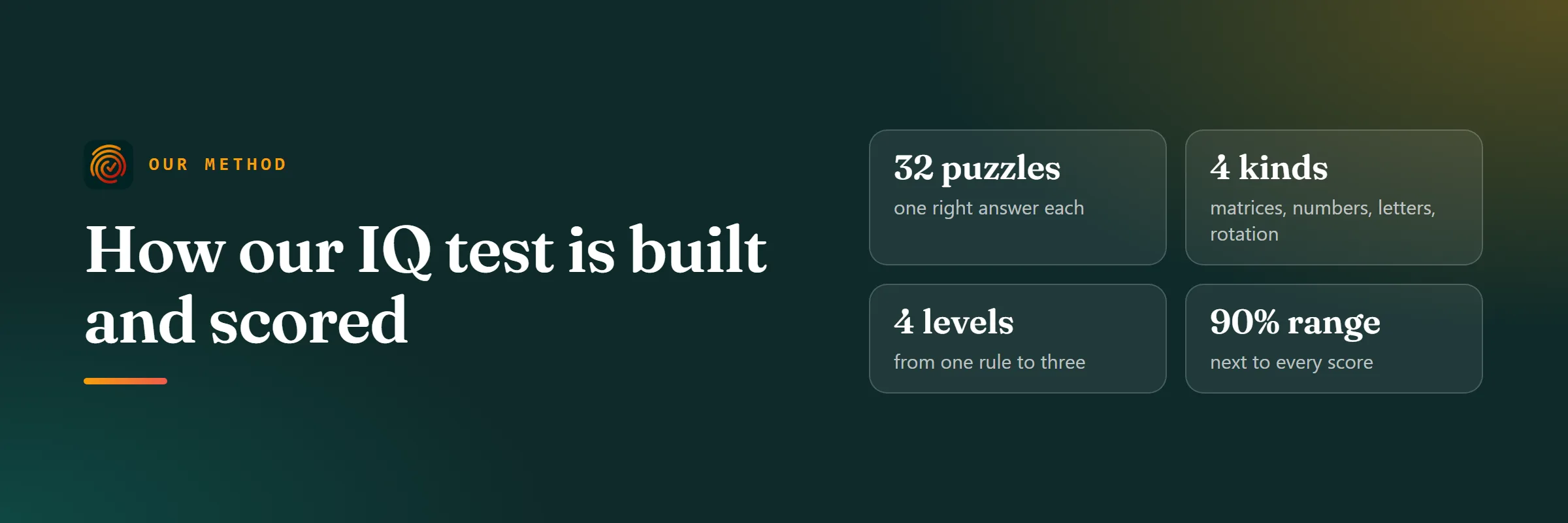
This page explains how the test works, which standards it follows, and where its limits are. We would rather you trust the number for the right reasons.
The structure
| Part | Our test | Why |
|---|---|---|
| Puzzles | 32 | Long enough for a usable estimate, short enough to finish in one sitting. |
| Time | 25 minutes | About 47 seconds a puzzle. Mensa's online challenge gives 35 puzzles in 25 minutes. |
| Types | Pattern matrices, number series, letter series, mental rotation (8 each) | The same families as the public-domain ICAR research test, with numbers in place of verbal items. |
| Difficulty | 4 levels, easy to hard | Like the sets of Raven's Progressive Matrices, each level adds a rule to track. |
| Options | 6 per puzzle | Keeps lucky guesses rare: one in six. |
One right answer, checked by code
Every puzzle is generated for your test, so nobody can learn the answers in advance. Before you see a puzzle, code checks it:
- Pattern matrices: every rule that holds across the first two rows and columns must hold in the third, and exactly one option may pass.
- Number and letter series: every simple rule that fits the shown terms must point to the same answer. If two rules disagree, the puzzle is thrown away.
- Mental rotation: the shape has no mirror symmetry, and exactly one option is a turned copy. The others are mirror images or near misses.
We ran these checks on 64,000 generated puzzles before launch. None failed.
How your score is worked out
We use item response theory, the method behind many modern tests. Each puzzle level has a difficulty value, and your number correct is placed on the IQ scale using those values. A lucky guess is allowed for, because each puzzle has six options. The same number correct always gives the same score, so one careless slip on an easy puzzle cannot drag you down more than a miss on a hard one.
The result is an estimate on the IQ scale (mean 100, standard deviation 15) plus a 90% range. The range is honest about precision: a short test cannot pin down an exact number.
What the four results mean
Eight puzzles per type is enough to show a tendency, not a separate IQ. So we compare each type with what a person at your overall level would usually score, and call it a relative strength, a relative weakness, or in line.
What we have checked, and what we have not
Checked before launch:
- One answer per puzzle. All 64,000 generated test puzzles passed the uniqueness checks above.
- Consistent reports. In 3,000 simulated results, the free result, the full report and the certificate always showed the same score, range and profile, and the same answers always produced the same report.
- Sensitivity to wrong difficulty values. We simulated 500 takers at each true IQ from 70 to 130, answering puzzles whose real difficulty deliberately differed from our values. Estimates then drifted low, by up to 6.6 points at a true IQ of 130. That is the size of error recalibration has to remove.
Not yet checked: we have no norming sample, no comparison with a clinical test such as the WAIS-IV, and no retest data from real takers. Until we do, we make no claim that our scores match a clinical IQ.
Known limitations
- Unsupervised. Nobody controls noise, tiredness, help from others or a second attempt.
- Provisional difficulty values. See the simulation above: if real puzzles are harder or easier than we assume, scores shift.
- Reasoning only. The test does not measure verbal comprehension, general knowledge or processing speed, which clinical tests include.
- Short subtests. Eight puzzles per type show a tendency, not a reliable sub-score.
- Practice effects. A retake scores a little higher because the formats feel familiar. Count your first attempt.
- Latin alphabet. Letter series assume familiarity with the A to Z alphabet.
How this compares with a clinical test
A clinical IQ test is given one to one by a trained examiner, takes an hour or more, covers several abilities and was normed on a large sample matched to the population. Ours is a 25-minute reasoning estimate with a stated range. Both report on the same scale, with a mean of 100 and a standard deviation of 15, so you can compare the numbers, but only the clinical score is valid for diagnosis, hiring or admissions. For those, see a qualified psychologist.
Changelog
- 14 October 2026: launch version. 32 puzzles in four types and four levels, provisional difficulty values, 90% range on every result.
Ready for the real thing?
32 puzzles, 25 minutes, your score and its range straight away.
Start the free test